


For many buildings, the roof remains the largest underused surface in the entire project. It is often treated as a technical necessity — a place for waterproofing, drainage, equipment, and little else. But in contemporary architecture and landscape design, rooftops are no longer just protective shells. They are becoming extensions of usable space, environmental performance, and visual identity.
A well-designed green roof can soften hard architecture, improve thermal comfort, support stormwater control, and create a more human-centered connection between building and landscape. Yet turning a bare roof into a functional planted environment requires more than adding soil and vegetation. It requires a system that makes design intent buildable.
This is where 200 mm modular green roof trays offer a practical design advantage. They create enough depth for more expressive planting while maintaining the order, repeatability, and installation logic that modern rooftop projects demand.
Why Rooftop Design Needs More Than a Shallow Green Layer
Shallow extensive systems work well for simple ecological coverage, especially where low maintenance and lightweight installation are the main priorities. But not every rooftop project is aiming for the same result. Hotels, residential podiums, public terraces, office rooftops, and mixed-use developments often need something more visually present and spatially engaging.
In these cases, planting depth matters. Deeper substrate profiles open the door to richer plant palettes, more stable root development, and a landscape expression that feels intentional rather than purely technical. A roof can begin to function less like a protected surface and more like an inhabitable outdoor environment.
The shift from coverage to design is exactly why semi-intensive green roof design has gained attention. It offers more possibilities than ultra-shallow systems while remaining more controlled and buildable than fully intensive rooftop gardens.
The Design Value of 200 mm Green Roof Trays
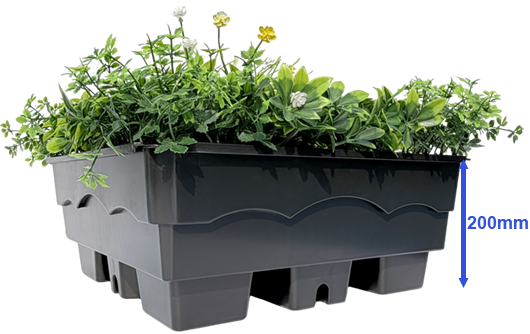
A tray depth of 200 mm creates an important middle ground for rooftop landscape design. It is deep enough to support more than a thin sedum layer, allowing a broader range of planting compositions such as groundcovers, ornamental grasses, perennial flowers, and selected low shrubs. At the same time, it remains modular and systemized, which helps keep the roof layout orderly and construction-friendly.
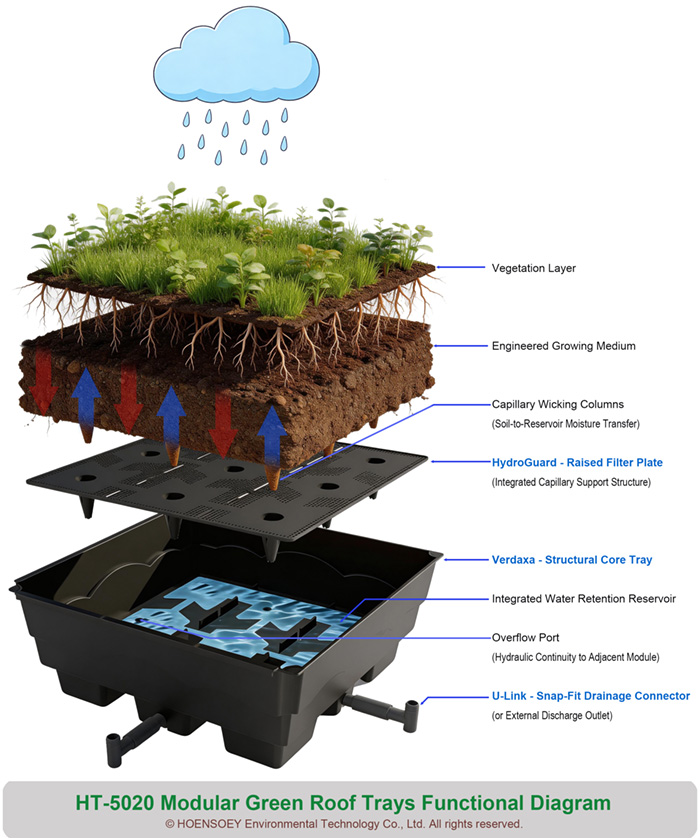
This balance is one of the strongest advantages of the HT-5020 modular green roof trays. With a module size of 500 × 500 × 200 mm, the system provides a clean planning grid while delivering a planting depth suitable for semi-intensive rooftop applications. It allows designers to create greener, fuller roofscapes without moving into a highly complex cast-in-place build-up.
For architects and landscape designers, this means more freedom at concept stage and more confidence at execution stage. The system supports design ambition, but in a format that still feels manageable.
Designing with System Logic, Not Just Surface Appearance
Good rooftop landscapes do not succeed by appearance alone. They depend on the invisible logic underneath: drainage, water retention, root zone stability, and buildable detailing. A visually attractive roof that performs poorly in water management or installation consistency is ultimately a weak design solution.
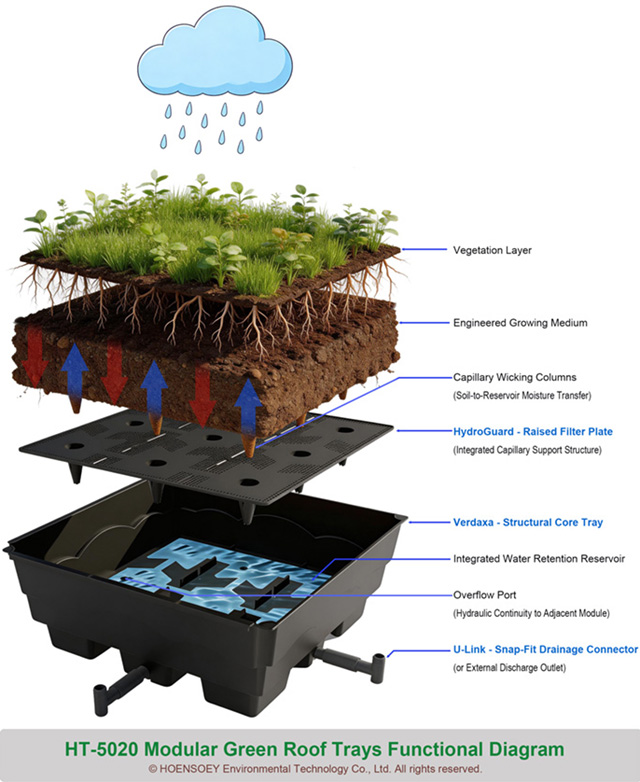
HT-5020 was developed as a three-part modular system consisting of the structural tray, a raised filter plate, and snap-fit drainage connectors. This integrated logic is useful from a design perspective because it reduces the gap between concept and construction. Rather than relying on loosely assembled layers that vary from site to site, the system introduces more predictable relationships between planting medium, water flow, and modular continuity.
The result is not just a greener roof, but a roof with more reliable system behavior — something that matters greatly when design quality is expected to last beyond the first season.
More Planting Possibilities for More Expressive Rooftops
One of the biggest limitations of shallow rooftop systems is visual sameness. When the planting profile is extremely thin, the roof often ends up looking more like a technical ecological layer than a designed landscape. That can be sufficient for some projects, but it does not always satisfy the spatial or brand expectations of premium developments.
With deeper modular green roof trays, the planting strategy becomes more flexible. Designers can work with texture, seasonal change, height variation, and stronger visual composition. Rooftops can feel softer, more immersive, and more aligned with the architecture below.
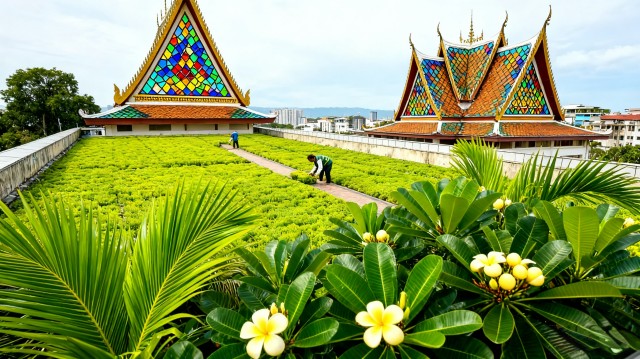
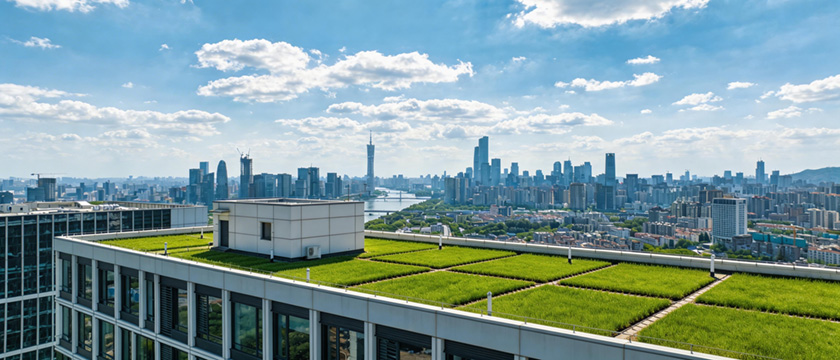
This is especially relevant for hospitality, residential, and commercial buildings where the roof is visible from upper floors, overlooked by adjacent towers, or directly accessible as an amenity zone. In those contexts, the roof is not hidden infrastructure — it is part of the user experience.
Suitable for Hotels, Residential Podiums, Public Buildings, and Urban Terraces
The most successful rooftop landscape systems are those that adapt well to real project types. HT-5020 is suitable for a wide range of applications including hotel rooftops, residential podium decks, office terraces, educational buildings, civic projects, and selected sloped roof conditions where controlled drainage and modular stability are important.
In these environments, designers often need a system that supports both environmental performance and aesthetic intent. The roof should manage water responsibly, protect the waterproofing layer, and still contribute to the overall visual language of the project. A modular semi-intensive system helps bring those priorities together.
A More Buildable Path from Concept to Completion
In design practice, the best systems are often the ones that protect ambition from being lost during execution. A beautiful concept can quickly be compromised if site assembly becomes too fragmented, too labor-intensive, or too dependent on interpretation. Modular systems help reduce that risk by introducing order.
HT-5020 supports a cleaner installation sequence through snap-fit connection, integrated filtration logic, and organized module layout. That can help contractors work more consistently and give designers more confidence that the finished roof will reflect the original intent with fewer on-site variables.
In this sense, the value of a modular tray is not only technical. It is also architectural. It helps make rooftop landscape design more deliverable.
Conclusion
As rooftop spaces become more important in contemporary architecture, the systems used to green them must support more than environmental compliance alone. They must also support design quality, planting depth, visual richness, and practical execution.
HT-5020 green roof trays offer a compelling answer for projects that need a usable middle ground: deeper than a basic extensive layer, but more modular and controlled than a fully built intensive roof garden. For architects, landscape designers, and developers, that balance can make all the difference.
To explore the full system, visit HT-5020 Semi-Intensive Green Roof Tray System. You can also learn more about our modular green roof trays and compare it with the HT-508 green roof module for shallower extensive roof applications.